Derek Hale
Holding Out for a Hero ▸ Stiles Stilinski (2)Derek Hale stands at the center of the book’s supernatural upheaval as the Alpha who succeeds Peter Hale. His rise does not end the danger created by Peter’s murders; it changes the form of that danger. With Derek at the helm, teenagers are turned into creatures of the night at an accelerating rate, making his new authority both a source of protection and a fresh threat. The book therefore presents Derek not as a stable heroic replacement for Peter, but as a volatile leader whose power keeps the crisis moving.
Identity and Rise
Derek’s status is announced through the imagery of his eyes: they flash bloody crimson, a visible sign that he has taken the Alpha position. The transformation places him in direct succession to Peter, whose death has stopped the earlier string of rabid Alpha murders but has also opened the way for Derek’s rule. Derek inherits the consequences of Peter’s violence along with the authority it made possible. His leadership begins under the shadow of that inheritance, and the narrative keeps the two Hales connected even when their methods and intentions are not identical.
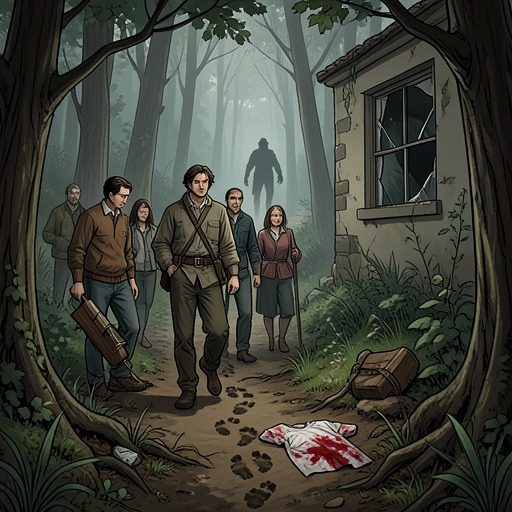
The Hale house provides the most immediate setting for Derek’s emergence. When Carson Bradley recognizes the sparse trees and realizes that the group has arrived there, the location produces dread before Derek even appears; the house carries the weight of the Hale family and everything associated with its supernatural history. Derek’s presence completes that recognition. The house is not merely a residence but the ground from which his new order is being established.
Leadership and Methods
Derek’s leadership is forceful and often invasive. During the full moon, he appears unexpectedly and orders Carson into the backseat, a small command that exposes the altered power arrangement around him: even movement and physical position become matters he can dictate. His authority also extends to the creation of a pack. Erica Reyes is described as newly remade when she escapes with Derek in the Camaro, with Derek occupying the driver’s seat. The image makes his role unmistakable. He is not simply accompanying a new werewolf; he is directing the departure and controlling the vehicle, the route, and the future represented by the transformation.
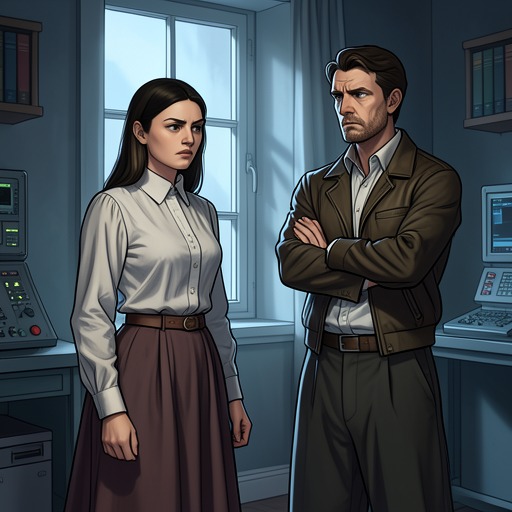
His pack’s actions place Derek in repeated conflict with Carson, Stiles Stilinski, and Scott McCall. In one confrontation, Derek is visibly shaken, and in another he challenges Carson directly, demanding to know what she saw. His questions are not offered as friendly investigation. They function as pressure, forcing information from someone already caught inside the supernatural conflict. When Carson asks what his problem is, Derek is shown smirking rather than reassuring her, emphasizing the gap between his certainty and her alarm.
Derek can also be brutally practical. After looking toward the roof and then at his two fallen betas, he tells Boyd to get them out of the area. The instruction is brief and managerial, treating the immediate aftermath of violence as a problem requiring removal and containment. Yet that same capacity for decisive action later makes him indispensable. When a gunman threatens the group at the McCall house, the opening door reveals Derek instead of Melissa McCall, and Carson immediately recognizes him as their possible way out because he is one of the few people capable of standing up to a lunatic with a gun. His danger and his usefulness are inseparable.
Alliances and Conflicts
Derek’s relationship with Scott is defined by rivalry that repeatedly becomes cooperation. Derek’s wolf hearing detects Scott before the others can fully respond, and his widened eyes and growl show that he remains intensely alert to Scott’s presence. The two do not share uncomplicated trust, but they occupy the same emergency network. Derek’s pack threatens the McCall household, while Derek himself can also become the person who intervenes when the group needs force or specialized knowledge.
His connection to Carson is especially unstable. Derek treats her as someone to command, move, question, and potentially confront, while Carson experiences his authority as a continual reduction of her freedom. The conflict is not only personal; Carson stands close to Stiles and Scott, the friends whose interests oppose Derek’s pack. Even so, Derek’s role cannot be reduced to an enemy’s. He later becomes part of the plan concerning Jackson, and his actions place him alongside the people attempting to prevent the Kanima crisis from continuing.
Derek’s pack relationships are similarly double-edged. Erica’s transformation demonstrates his willingness to create new supernatural allies, while Boyd’s position shows the expectation that members of the pack will follow orders even after violent confrontations. Isaac Lahey is associated with Derek in the final gathering, standing beside him in silence. That image is quieter than Derek’s earlier commands, but it suggests a pack structure held together not only by spectacle and force but also by shared recognition among people who have been changed.
Jackson and the Final Strategy
Derek becomes crucial to the attempt to stop Jackson Whittemore. When the group searches for a solution, Derek states that Peter Hale knows how to stop Jackson and perhaps even save him. The wording preserves two possible outcomes: destruction and rescue. Derek therefore occupies an uncertain ethical position, aware that the plan may require lethal violence but still naming salvation as a possibility.
Derek insists that he has looked everywhere when Peter’s knowledge is questioned, revealing both frustration and the limits of his own resources. He is not presented as omniscient. His authority cannot solve the Kanima crisis by itself, so he turns toward the very relative whose murderous Alpha history preceded his own rise. This return to Peter makes Derek’s arc circular: the successor must consult the predecessor, and the new Alpha’s attempt to control the crisis leads back to the older source of supernatural knowledge.
The final confrontation confirms the lethal side of the plan. Jackson lowers the key and steps away from Lydia Martin while Peter watches from the sidelines. After Jackson gives a single nod, Derek and Peter attack from opposite directions, extending their claws through Jackson’s abdomen. Scott steps forward but cannot intervene. The two Hales lift Jackson, withdraw their claws, and let him fall; Carson realizes that they have not come to help him but to kill him. Derek’s participation makes the scene a decisive statement about his leadership. Even when saving Jackson remains part of the stated possibility, Derek accepts an action that appears to be execution.
Change, Ambivalence, and Narrative Role
Derek’s significance lies in the contradiction between the color of his power and the uses to which that power is put. His crimson eyes announce an Alpha whose rule expands the supernatural threat, and his commands, coercive questioning, and pack-building make him frightening. At the same time, he can be the group’s strongest immediate defense, the person who hears danger first, and the strategist who connects Peter’s knowledge to Jackson’s fate.
The final tableau keeps that contradiction unresolved. Derek stands with Isaac while Scott and Allison Argent hold hands, Chris Argent remains silent behind them, and Peter has just participated in Jackson’s killing. Derek is neither absorbed into Scott’s circle nor expelled from the story’s moral field. He remains at its edge, aligned with allies when necessary but still marked by the methods of the Hale family. His decisive role is to make the supernatural world impossible to treat as a simple battle between heroes and villains: the Alpha may be a threat, a shield, and an executioner within the same chain of events.